
| Sediment Removal & Water Quality Pond Maintenance |
 | |  | |  | |  | |  |
We provide 3rd Party Inspections, Sediment Removal, Repair and Water
Quality Pond Maintenance Services.
In the Austin area most commercial developments and institutional
campuses are required to protect the watershed from pollution which is
washed from parking lots, building roofing and other concrete surfaces when
it rains. We can assist you with the documentation, bi-annual maintenance,
repairs and sediment removal to maintain your water quality pond.
If a water quality pond takes longer than 48 hours to drain through the sand
filter bed, it is not working properly and maintenance is required.
Some of the local authorities which have water quality maintenance
requirements are listed below. Click one of the four below underlined links to
view and learn more about the current water quality regulations.
1) The City of Austin
2) The City of Bee Cave
3) The Lower Colorado River Authority
4) Texas Commission for Environmental Quality (TCEQ)
We provide full service bi-annual regular inspections, testing, excavation,
haul off and disposal of the sediment which naturally collects, to clean up and
maintain the functionality of your parking lot water quality sedimentation /
filtration pond or basin.
Water Quality Ponds are some times called (BMPs) Best Management
Practices, they can be called sand filter basins, sedimentation/filtration ponds,
SOS ponds, wet ponds, extended detention ponds and various other names.
These water quality ponds filter the rainfall runoff from parking lots, and
should be inspected a minimum of 2 times a year for maintenance and
occasional sediment removal. Commercial Engineering utilizes our vacuum
excavation equipment to remove sediment and the crust which naturally
builds up in the sediment forbay or on top of the sand filter layer.
By using our mobile vacuum sediment excavation machinery we are able to
safely overcome many maintenance accessibility limitations, such as walls,
fences and rock gabion baskets. Don't risk damaging perforated, underdrain,
plastic pipes by the weight of an excavator or small tractor loader carelessly
removing material.
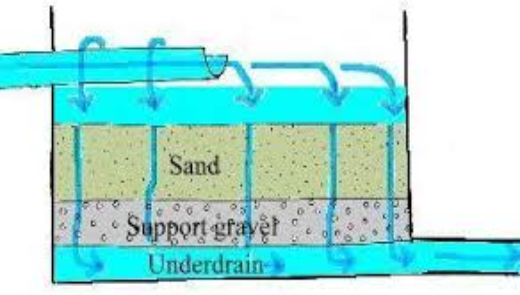
Below is a cross-sectional view of a typical sand filter system. A filter fabric
separates the sand layer from the gravel support bed around perforated
plastic PVC underdrain pipes. The science behind this filter system has been
used for hundreds of years to purify water and remove pollutants.
For TCEQ water quality ponds a sediment sample is first collected, then lab
analyzed prior to any sediment removal and disposal. This is done in order to
meet regulatory review requirements as written in the Complying with the
Edwards Aquifer Rules: Technical Guidance on Best Management Practices,
before a tract of land can be permitted for construction development.
In some cases a soil collection sample from each water quality pond is
analyzed in a lab to measure the concentration of 12 different heavy metals
and the petroleum hydrocarbons content (vehicle fluids) so that it can be
disposed properly, in the correct type of landfill. Note: Onsite disposal is only
allowed if you have a landfill permit issued by TCEQ.
Some other general maintenance checklist items we can help
you with include:
repair of corrosion
sand filter media replacement
under drain PVC pipe cleaning and repair
mowing and vegetation maintenance
trash removal
grading to prevent stagnant water ponding
pump service and dewatering
masonry rock wall and concrete mortar repair
replace or repair rock gabion basket structures
Keep the ponds functioning properly and you can
do your part to protect our beautiful environment
here in Austin.
Quality Pond Maintenance Services.
In the Austin area most commercial developments and institutional
campuses are required to protect the watershed from pollution which is
washed from parking lots, building roofing and other concrete surfaces when
it rains. We can assist you with the documentation, bi-annual maintenance,
repairs and sediment removal to maintain your water quality pond.
If a water quality pond takes longer than 48 hours to drain through the sand
filter bed, it is not working properly and maintenance is required.
Some of the local authorities which have water quality maintenance
requirements are listed below. Click one of the four below underlined links to
view and learn more about the current water quality regulations.
1) The City of Austin
2) The City of Bee Cave
3) The Lower Colorado River Authority
4) Texas Commission for Environmental Quality (TCEQ)
We provide full service bi-annual regular inspections, testing, excavation,
haul off and disposal of the sediment which naturally collects, to clean up and
maintain the functionality of your parking lot water quality sedimentation /
filtration pond or basin.
Water Quality Ponds are some times called (BMPs) Best Management
Practices, they can be called sand filter basins, sedimentation/filtration ponds,
SOS ponds, wet ponds, extended detention ponds and various other names.
These water quality ponds filter the rainfall runoff from parking lots, and
should be inspected a minimum of 2 times a year for maintenance and
occasional sediment removal. Commercial Engineering utilizes our vacuum
excavation equipment to remove sediment and the crust which naturally
builds up in the sediment forbay or on top of the sand filter layer.
By using our mobile vacuum sediment excavation machinery we are able to
safely overcome many maintenance accessibility limitations, such as walls,
fences and rock gabion baskets. Don't risk damaging perforated, underdrain,
plastic pipes by the weight of an excavator or small tractor loader carelessly
removing material.
Below is a cross-sectional view of a typical sand filter system. A filter fabric
separates the sand layer from the gravel support bed around perforated
plastic PVC underdrain pipes. The science behind this filter system has been
used for hundreds of years to purify water and remove pollutants.
For TCEQ water quality ponds a sediment sample is first collected, then lab
analyzed prior to any sediment removal and disposal. This is done in order to
meet regulatory review requirements as written in the Complying with the
Edwards Aquifer Rules: Technical Guidance on Best Management Practices,
before a tract of land can be permitted for construction development.
In some cases a soil collection sample from each water quality pond is
analyzed in a lab to measure the concentration of 12 different heavy metals
and the petroleum hydrocarbons content (vehicle fluids) so that it can be
disposed properly, in the correct type of landfill. Note: Onsite disposal is only
allowed if you have a landfill permit issued by TCEQ.
Some other general maintenance checklist items we can help
you with include:
repair of corrosion
sand filter media replacement
under drain PVC pipe cleaning and repair
mowing and vegetation maintenance
trash removal
grading to prevent stagnant water ponding
pump service and dewatering
masonry rock wall and concrete mortar repair
replace or repair rock gabion basket structures
Keep the ponds functioning properly and you can
do your part to protect our beautiful environment
here in Austin.

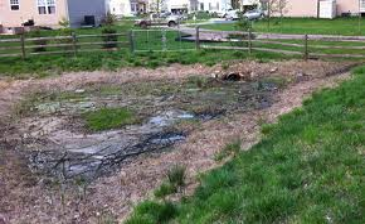
Example of an unmaintained sedimentation pond.
New clean basin before sediment buildup.
Notice the clean sand filter media.
Notice the clean sand filter media.